

Things were not where they were supposed to be. The bookshelf, which primarily displayed glass globes and geometric vases, was closer to the door by a half foot. Torn postcards proclaiming “Welcome to the Airspace!” in sans serif were strewn about the living room like pieces of dead earthworm after a rain.
The couch had been inched to the side, bunching up the sheepskin rug around the metal legs of the glass-topped coffee table. The dead animal’s curls moped, as though the disarray added insult to injury.
Adam grimaced at the thought of the company’s annoyance. Put your back into it, he thought, and then self-corrected when the memory of a long-ago personal training session surfaced: no, your legs. Put your legs into it.
He gripped the high end of the white Ultrasuede sofa and shifted it back. Its lightness surprised him, which then also surprised him. Everything in the apartment was exactly as it was expected to be, which meant it was sold through an aggregate site that marketed its composite wood as nearly the real thing.
The building bot flashed on by the doorway to count down the minutes Adam spent in each room. “Never stop learning, never stop maximizing!” the bot sang.
The bathroom held little shock: soap scum on the glass shower door, towels piled by the double sink. This he could handle. Adam slid his rubber gloves on and sprayed bright blue cleaner on the shower.
When he bent down to wipe away the foam, Adam slid his entire body between the counter and the toilet. That was when he noticed it. The toilet itself had been moved.
Was it possible? There was no change to the plumbing, no gap in the floor tile. But sure as shit, the toilet was in a different place than it had been a few days ago.
Was he just stupid? Was it the repetition of taking care of every apartment in this building that repeated one of three exact layouts: one bedroom, two bedroom, corner two bedroom? Did any of them have a gap between the double sink and the toilet?
Not that he could recall. He’d check the next one. That guest had requested a late checkout from the bot and he had an hour before his inspection started.
“Onto the next adventure!” the bot chirped.
***
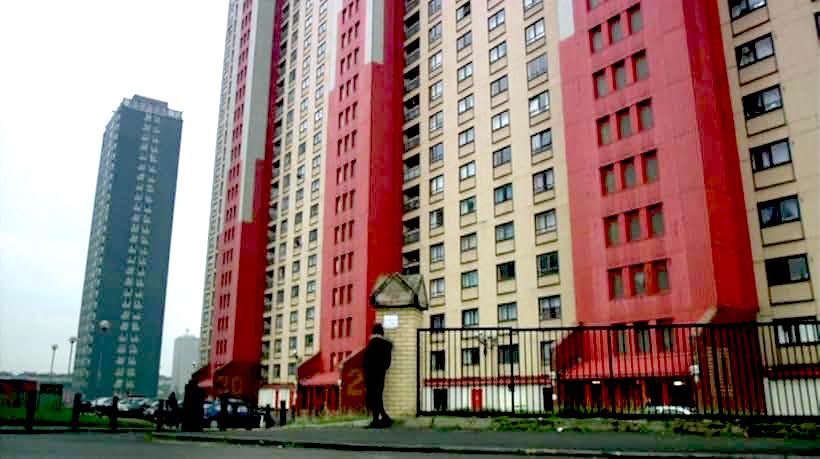
Adam had worked inspection for the Airspace building since its soft opening. It was the first in a planned series of skyscrapers opening every two months in every major city in the country for a year then expanding around the world. They were to be the first of their kind: specifically designed vacation housing owned entirely by the internet corporation that had helped residents rent out spare bedrooms when they were out of town.
The company had gobbled up multiunit dwellings in historic neighborhoods with impressive speed; whatever they didn’t get, speculators latched onto then used vicious tactics to evict the long-term tenants. But even those had started to run out. Empty space wasn’t just at a premium; it was impossible to find on the ground.
If the company wanted to keep growing, it had to enter the business of airspace.
Each building would be exactly the same as the next in terms of footprint, square footage, even down to the interior design. Each living room would have the same coffee table books (Richard Avedon photos, a visual history of South African hip hop, Oaxacan women’s artisanal textiles) plus one focused on street art of the city the building inhabited.
Each bathroom would have exactly six ivory Turkish bath towels with matching washcloths. The walls of each apartment would be painted a bespoke greige named “Castle in the Sky.” The paint was available from the company’s web site alongside the trademarked room fragrance “Ether.”
Because the mode of the time was prediction slipping neatly into manifestation, everything went according to plan. By the time the building launched, every apartment was booked in three-day spans for a solid year out. There was a lot of money to be made.
Adam’s building had been open for eighteen months. In the past six, exact copies had launched in Hong Kong, Dublin, and Dubai. Each edifice matched his because it was the original, though determining “original” was increasingly difficult. He wondered if the clientele also matched: thirty-something jetsetters, coffee in hand, bags filled with neutral-colored slouchy pants and bright white designer sneakers, running gear for the mornings and tailored shirts and blouses for the evenings.
Each location came equipped with a set of portals on the first floor that showed, in real time, what was happening in the same lobby space in every other Airspace property. Generally, that was nothing. But if Adam spent too much time in his building’s lobby, he began to disassociate. And while he hated his job, he hated even more the thought of returning to group therapy.
The Airspace marketing team developed a fan base by advertising the comfort of familiarity in the midst of discovery. Find yourself in a vibrant city center right where the locals enjoy the fruits of their cultural heritage; in the Airspace, you can look out on where everything happens. Experience how travel sustains you. Observe how other people live. Take a long shower.
There were guests who had made it to every single tower already, some twice over. They loved it, so high up in the air, so far above, like birds of prey circling over mice scurrying through a wheat field.
The Airspace smelled lofty and ethereal like its trademarked fragrance. It felt like floating on a silver cloud, buoyed up by jet streams and abstraction. Michelin-starred restaurants cropped up nearby as soon as construction started on an Airspace building. When the guests ate rare cuts of meat there at night, they savored it as though it came precut from heaven.
The guests were of the air, too, and wouldn’t eat again until the next afternoon, not because they didn’t have the money to but precisely because they did. Nothing felt richer than that empty feeling.
***
It was therefore easy to see when something was out of place. The guests typically didn’t do that; they followed the Airspace rules as though they were eternal commandments. Adam checked the last guests just in case and found a perfect record of behavior and payment at four other Airspace locations.
What had happened in the apartment, then, had nothing to do with them. That became clear when Adam entered more apartments.
Down the hall, the never-used oven was pressed shoulder-to-shoulder against the refrigerator; the toilet again was moved, but this time closer to the door. In the next, the closet doors were ajar and would not fully close no matter how much Adam pushed; they simply stopped moving with six inches to go. In another, the leather handles on the decorative trunk in the bedroom were inside out and, even worse, appeared to have bits of wet gristle clinging to them as though they weren’t fully processed and tanned. The kitchen sink, otherwise pristine, held a Styrofoam package of raw skinless chicken breasts glistening behind plastic. Tiny maggots pressed their blind bodies against the cling wrap.
“Sink cleaning needed,” the bot twittered from the door camera.
Things got worse.
For the next few weeks, each apartment Adam entered after the bot informed him of automatic check-out held some vile leaving that made memories of the chicken turn pleasant. Three enormous and stinking mammalian teeth side by side on the cream-colored sofa as though a primitive animal dentistry had just been interrupted. A pile of bloody rodent bones in a corner of an otherwise tidy living room. What looked like giant owl pellets, replete with entire undigested infant mice, in the bathtub. Dirt and roots tangled up under the bed that, once Adam pulled them out, revealed most of a desiccated clawed foot wrapped up inside.
Adam filed notices with the company, but the bot insisted that the guests had all been vetted.
“Everyone’s family in the Airspace,” the bot cheeped.
But the fleshy bits just kept appearing. Even discarding them was hard; when he tried to send them down the trash compactor, lights blinked on and the bot’s voice announced that organic material was not allowed in the Airspace chute. And so Adam found himself lugging shopping bags of animal parts from the building until he could find a dumpster with its bot turned off.
A pigeon sat to the side of the one he chose and cocked its head at him. When Adam ignored it, the bird turned back to pecking at the half-eaten chicken wing it had found in the gutter.
Adam tried to contact workers at other Airspace buildings to see if the same thing was happening to them. But the “Who We Are” page only showed the board of directors, none of whom had a publicly posted email address. It was as though Airspace buildings ran on nothing, like the intermittently fasting guests getting in their five miles at six AM before a day of can’t-miss sights.
Adam had started to feel like he, too, was nothing. Nothing but a pack mule weighed down with bodybags in search of an autopsy and a proper burial.
***
Then the birds appeared.
Few things threatened the illusion of the Airspace’s emptiness like migrating songbirds crashing en masse into the picture windows and plummeting forty stories to their deaths. The building’s windows were processed with a new polymer that generated an electrical current and emitted a constant >20,000 hz drone to repel avian life. In their annual reports, the board proudly proclaimed a perfect rate of zero bird death across all Airspace buildings, a statistic they intended to highlight when applying for B Corp certification.
“External window cleaning needed!” the bot sang at Adam when he entered the next apartment. “Sorry.”
Adam groaned; it was an arduous task involving unlatching a series of childproof locks, climbing a ladder to get close to the ceiling, and leaning halfway out a sliding upper panel to scrub the one below. The company hired window cleaners to scale the curtain wall every week. For this urgency, it must be bad.
When he came through the entryway he saw that it was, indeed, bad.
“Sorry! It is bad,” the bot croaked.
The main window was fully coated top to bottom with a slurry of blood, guts, feces, feathers, and eyeballs, as though an entire flock had crushed themselves at the same time against the glass.
Adam dragged the ladder over to the window.
“Everyone tells their own story in the Airspace,” the bot sang.
An hour later, the window still wasn’t clean, but Adam had to move on. But each of the next three apartments on his list that day revealed the same situation: avian massacre filling up the empty space.
At the end of the day after microwaving his leftover Peking duck, Adam sent a message to corporate explaining the polymer had failed and requesting an earlier window cleaning service. No one ever responded.
***
By the following week, legions of dead baby birds had migrated inside the apartments. Adam took to stepping gingerly into each apartment, wary of putting his foot into a little crunch-boned dinosaur.
“Watch your step,” the bot chirped. “There’s fun lurking around every corner.”
Adam did what he could and fantasized about quitting. At home in his efficiency, he drank himself into a stupor with a half bottle of leftover vodka he found in the cabinet and tried to erase the lingering smell of bird shit and rotten egg from his nostrils. Clouds of sulfur diluted whatever beauty remained in his dreams.
Guests must have been checking into the Airspace but Adam never saw them nor heard any complaints about subpar accommodations.
What he did notice on his way home at night was the increase in rats. They crowded alleyways as though flooded out of the sewer systems. But they didn’t seem aggressive; quite the opposite. In fact, Adam could swear they seemed on edge.
Gulls circled overhead, screeching at all hours of the day and night. God knows how they’d found their way this far inland. Adam hid his lunch deep in his backpack on the way to work for fear they’d divebomb and accidentally – or purposefully – jab out his eyes.
***
Adam was halfway through the lobby when he saw it. Masses of dead sparrows piled up under the portal wall. Though he tried to avoid the vertigo from looking through the portals, he stopped and stared. Each portal reflected exactly the same lobby, down to the hundreds of dead birds piled up in the foreground.
“Good morning!” the bot cheeped. “It’s a great day to explore!”
And so while corporate had instructed him to start at the twentieth floor, Adam began his day at the top.
Cold air rushed at him as soon as he opened the door to the first apartment on the seventy-fifth floor. Mist rolled over the back of the sofa and across the sheepskin rug. Shattered glass lay next to every wall, each one of which was now held up merely by the empty metal frames where the floor-to-ceiling windows should be.
Damp wind whistled in Adam’s ears. A low-hanging cloud drifted past the living room. Vertigo rattled him between the ears, and Adam barely caught himself before he tumbled out the newly open walls.
We are high in the air, Adam thought in desperation. Nothing can reach us. All the death and fear and repressions that plague us, they can’t push elevator buttons. We’re high in the air.
The foundations of the buildings shuddered. From the depths of the ground that had formerly seemed so empty, merely like space primed for building, came a great and hungry call.
From above the rooftop, from the space that had formerly seemed so empty and primed for building, from some prehistoric creature of the skies alerted by its children’s pain, came an answer.
The composite wood plank floor around Adam’s feet heaved at the seams and cracked open. Bones and gore and claws and down forced their way up through the crevices, at first in a slow bubble and then with increasing force. Fountains of blood burst through and rained terrible sights and smells onto the walls and fabrics.
As quickly as Adam wiped blood from his eyes, more coated his vision. He turned his head upward to escape it, just in time to see the ceiling bow and cave. With immeasurable force the ceiling broke in two, punctured as though by an enormous talon. Galactic storms ripped the sky apart with thunder, lightning, and driving torrents of rain.
Piercing screeches erupted from every possible angle. Through the ceiling tear, Adam could see a strange darkness descending, weighted with the noise of infinite feathers. The majority of the sky above the building was consumed by what at first seemed a supermassive black hole. But all its writhing and movement coalesced into a maelstrom of black wings spiraling around a single unblinking golden eye.
What surveils our temperate garden when we think we’re the ones looking down?
The eye drew nearer and what Adam had taken for an iris clarified into multiple circles of teeth. They extended in an unfathomably long tunnel of a throat that reached toward infinity. As he gazed into it, entranced, it emitted a ghostly and mysterious song like millions of birds greeting the first rays of dawn.
Behind Adam’s shoulder, a light by the door flashed on.
“Welcome to the Airspace,” the bot chirped. “And hello to the first day of the rest of your life!”
-- Jocelyn Szczepaniak-Gillece teaches Film Studies at the University of Wisconsin-Milwaukee.