

I loaded the samples in the FE SEM’s chamber and switched on the vacuum; that gave me a half-an-hour to myself while the pump got the pressure down to the required 10-13 atmospheres, so I figured I had time to blaze one under the chemical hood. Dr. Demir, who ran the whole Analytical Lab, had “asked” if someone wouldn’t mind riding the machine overnight, and as a grad student whose tuition remission depended entirely on staying in her good graces, I’d happily “volunteered.” Graveyard shift in the lab, 11 p.m. to 8 in the morning; I figured I deserved a treat.
I rolled the joint in the clean lab. They used special bulbs in there, clean bright light for sample prep without any degrading UV. The glow always seemed fuzzy or something to me though, and it made the shadows look odd, a little too crisp, if you know what I mean? Anyway, that was why, as I shook weed onto paper, I didn’t wonder too much at the weird iridescence that shimmered on the edges of the leaves. My previous guy had found Christ and given it all up, so now I was buying from someone new. Maybe his weed just glowed that way; maybe it was real resiny? I flipped on the fan, stuck my head in the cabinet, and sparked up.
The smoke settled thickly on my tongue and a flavor of spice echoed fulgently against my tastebuds as I held the cloud in my sinuses. Exhale; I watched the smoke rippling up the hood vent and imagined it roiling through the pipe and out the roof to join the clouds that hid the moon above – was the smoke a different color too? An oil sheen shine seemed to hang in the air, the same color that had coated the leaves.
Next thing I know, I’m hearing the beep from the pump on the FE SEM, letting me know we’ve achieved vacuum. I’d blinked and thirty minutes had gone by somehow, bam, just like that! I grinned and looked at the stub of a joint perched gingerly between thumb and pointer finger – time travel like that meant my new guy hadn’t been lying when he said he had good shit.
I killed the last centimeter and then dogpaddled back to the machine. I was definitely feeling the ol’ half-second lag between intention and action, but so far nothing bad or off-putting seemed to threaten. I generally just floated on weed anyway, and was never really subject to The Fear or anything like that. I just settled into the chair, took a big drink of water from my bottle, and got the ol’ tungsten source fired up.
Big list of samples to run tonight; it was a DoD funded project, routed through Idaho National Laboratory, which is where Demir got the grant for the Analytical Lab. We had a good set-up, lots of different machines and different techniques all under one roof, nice situation for everyone involved. Year of consistent funding at least, real sweet deal.
Tonight’s program was a bunch of backscatter emission spectra, music by physics with me conducting. Electron backscatter diffraction is a fun technique – you blast a sample with a beam of electrons, and given a material’s particular crystallographic orchestration, the beam is reflected (or scattered back, as it were) in specific and very characteristic ways, providing you with all sorts of data: composition, sure, but also orientation and textures and grain sizes of material, condition of alloys, real science fiction scanner shit.
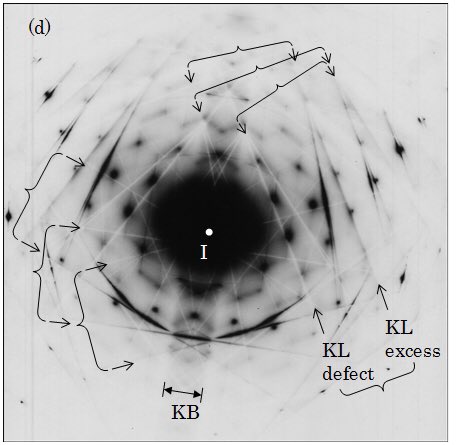
But, data aside, the real treat is the trippy images they produce – cabbalistic crosses, wildly angled cages, tessellated roadmaps of Martian canals. They’re called “Kikuchi lines,” patterns produced by diffraction of the electron beam in atomic orientation space, and they’re really spectacular. I was looking forward to seeing them enhanced by my, ahem, chemical augmentation from earlier.
Got the charge up to 20 kV, and the movement of my finger against a button sent a beam of electrons from a heated tungsten source screaming at the speed of light through the tiny vacuum of the machine, where it bounced off the sample, zinged around the chamber, and then was captured by the filament detector of the FE SEM.
Pure wizardry.
And on the screen a molecular flower bloomed in black and white and gray, lines and bars cosmically straight, a twelve-armed cross realer than anything you could ever see in everyday life: a sigil representing fundamental atomic reality.
Usually I had to rotate the sample stage to get ‘em to spin like that, but with all the smoke in my head they were already twirling, like space stations in orbit. I leaned back and grinned and said aloud to the empty room:
“Better than laser Floyd, man.”
But work was work; carefully and deliberately I took snapshots of the spectra of the sample from various angels, huge files full of raw data, making sure with each one that I was preserving the sample naming convention that the DoD had given us: Maury_Island_1, Maurey_Island_2, Maury_Island_3. Raw files safely stored on the server, I then ran an analysis, and goggled at what came up.
Samarium oxides, yttrium chalcogenides, pure tellurium. An insane combination of rare earth materials I never even heard of, the sort of stuff you made in a lab. Nothing like what you’d scrape off the ground from someplace, out in the world, out in nature.
I was cottonmouthing pretty bad, so I drank more water and took a quick stroll around the lab, although I felt like I was carrying my head around like a balloon on a string. Maybe I was still a little too blazed? When I got back to the machine I ran the first sample again, and sure enough, got the same results – impossible lanthanides, something out of a synthetic chemistry textbook.
All I could do was repeat the Light Brigade’s mantra and move on to the next sample on the stage, something labeled “Shag Harbor.” Again the million-petalled lotus blossomed up on the screen, and again the analyses came back, crazier than a box of frogs. This time the star of the show was promethium, present as α-Pm, β-Pm, monoclinic Pm2O3, all of them the exceedingly rare product of very particular fission reactions. I shivered and fought down the anxiety clawing at my guts, but I really wished I’d taken a Geiger counter to the samples before I’d loaded them up.
Third sample, but this time the Kikuchi lines seemed less “architecture of the universe” and more “bars of a cosmic jail” to me, hard rays that seemed to surround me, awful in their finality. I ran the analyses and compared the spectra to the cached library of a billion indexed references.
Nothing.
Unidentifiable.
I moved the beam off the sample, measured the humdrum holder itself and saw the old familiar chromium and titanium oxides of the machined metal. No problem with the beam then. Blasted the third sample again, took spectra, and ran the analysis.
Unidentifiable.
I was really sweating now, felt it running down my back and beading in my eyebrows. When did it get so hot in here? I decided I’d better just save the mystery data on the server and move on – this was all above my pay grade anyway. I flipped through the client’s sample list and found the name they’d used for this third unidentifiable sample.
Roswell.
“Okay,” I said, shaking out my arms and legs and neck. “Time for a break.”
***
The weed must’ve been stronger than I’d realized, because I had a hell of a time finding my way to the vending machine. To protect the lab from vibrations it’d been built in the basement of the new physics department, so there were no windows to get your bearings by – either you knew where you were going, or you navigated by The Far Side comics pinned to the doors. Normally, you head left out of the lab, straight on until you hit “Cow Tools” and then hang a right, and you’re there, at the good vending machine with King Felix brand pretzels (my favorite). Somehow, though, I’d lost my way, and furthermore the principles of cartoon navigation were failing me; I didn’t even see a Far Side on the door nearest me, for instance. Instead, someone had pinned up something called “The Machine Elves,” a four-panel strip where a pair of weirdly fractal figures seemed to be hitting each other with hammers. At least, that’s what I thought was happening; I couldn’t actually read it since all the text was in Greek or something. I leaned in and squinted.
“ἀλλ᾽ οὐ τοῖον ἔτευξε καὶ οὐ τόσον οὔ τινι φειδοῖ,” said the first fractal figure, before walloping his compatriot with a hammer.
“οὓς φύσις ἀνθήσασα μέσοις ἐνὶ βένθεσι πέτρης!” retorted the second figure, raising his hammer, but then turning and looking at me. The fractal thing on the sheet gestured towards me and said something else that made his friend laugh. Then, with a Mandelbrotian wiggle, they stepped out of the paper and into the hallway.
I ran then, my feet sinking into a floor that had taken on a rubbery texture that undulated unpleasantly beneath my soles. I heard the fractal things pattering along behind me, giggling and chirping in their strange language. I stumbled and tripped, but got up and eventually reached a door.
Like I said, I thought I was in the basement, but when I burst through the door I found myself outside, in the courtyard of the physics department. Everything was quiet and still – it was well after midnight and the only sound were the whippoorwills calling to each other in the fir trees that lined the distant quad. It was also very dark – none of the lamps were on, and there were also no lights in any of the offices. The only glow came from the moon directly overhead.
I looked up at it, trying to catch my breath. It was bright, brighter than I’d ever seen the moon, and as I stared it seemed to be growing brighter. I was having a very hard time breathing – the air felt thin, and no matter how much I gulped it didn’t seem to be enough to fill my lungs. Meanwhile the moon kept growing brighter and brighter – I couldn’t see the usual mare or craters or blemishes at all now, it was just a perfect circle of violet-tinged light. In fact, it was getting too bright – I couldn’t look directly at it anymore. I shielded my eyes and looked away, focusing on the purple pools of illumination coalescing like ponded rain in the courtyard.
And wherever I looked, at my feet, on the walls, anywhere touched by the light of the too-bright moon, all I could see were tessellated roadmaps of Martian canals, wildly tangled cages, and cabbalistic crosses, the backscattered diffraction patterns of Kikuchi lines erupting from every surface and angle and line around me.
-- Eric Williams is a writer living on the lithified remains of a Cretaceous seaway in Austin, TX. He has published a collection of weird fiction, Toadstones (Malarkey Press, 2022), and selected, edited, and wrote the introduction for Night Fears: Weird Tales in Translation (Paradise Editions, 2023), a collection of the translated fiction that appeared in Weird Tales magazine in the 1920s-40s.