

Views of the Body(wO) in Browning and Ishii
Mark Fisher, in a blog post entitled spinoza, k-punk, neuropunk[1], summarizes Spinoza’s Deleuzo-Guattarian legacy:
According to Spinoza, to be free is to act according to reason. To act according to reason is to act according to your own interests. Finally, however, we have to recognize that, on Spinoza's account, the best interests of the human species coincide with becoming-inhuman.
What’s so difficult about this? Fisher identifies two issues innate to the “Human OS”: our physiological arborescence, or the branchlike nervous system rooted in the vertical trunk-structure of our spine, and mankind’s physiognomy's subordination to a commandant noggin that neurologists say is functionally tricameral, therefore prone to all kinds of psychical mix-ups, torsions, neurologic competitions between what we’d like to do and what we really better ought. It’s this problem of health against hardwiring that leads Fisher to say that becoming-inhuman is in humanity’s best interest; but it’s the extant hardwiring that almost forecloses on the possibility of health.[2]
What’s called for is disassembly and re-organization. Happily, Fisher finds destratifying potential latent in the same “hideously collocated morbid assemblage” we take for woeful subjectivity. A convoluted brain might convolute the body it's in. Fisher terms this program cyberpunk:
Cybernetics does not only refer to technical machines. Wiener calls it the study of control and communication in animals and machines… The whole point of cybernetics is that nothing is 'more cybernetic' than anything else…
If cyborgianism is oriented towards a maintenance and reproduction of the organism and its homeostatic control circuitries, Cyberpunk or k-punk… flees towards a cybernetics of organic disassembly… What matters is the overall organization of the parts. Do the parts operate as hierarchically organized and functionally-specified 'organs' within a cybernegatively construed interiority or do they operate as deterritorialized potentials pulling from/ towards the Outside?
This latter arrangement is what Deleuze and Guattari, following Artaud, designate the Body without Organs…
Is Tod Browning the greatest technician of an American cyberpunk? His melodramas evince equal ambivalence toward and intimacy with social peripheries, deformity, libido, repulsion and fascination. Both his silent and talkie masterpieces construct novel bodily assemblages; textually, these are grotesquerie exhibitions, but in fact they dramatize shocking and provocative processes of dis-organization.
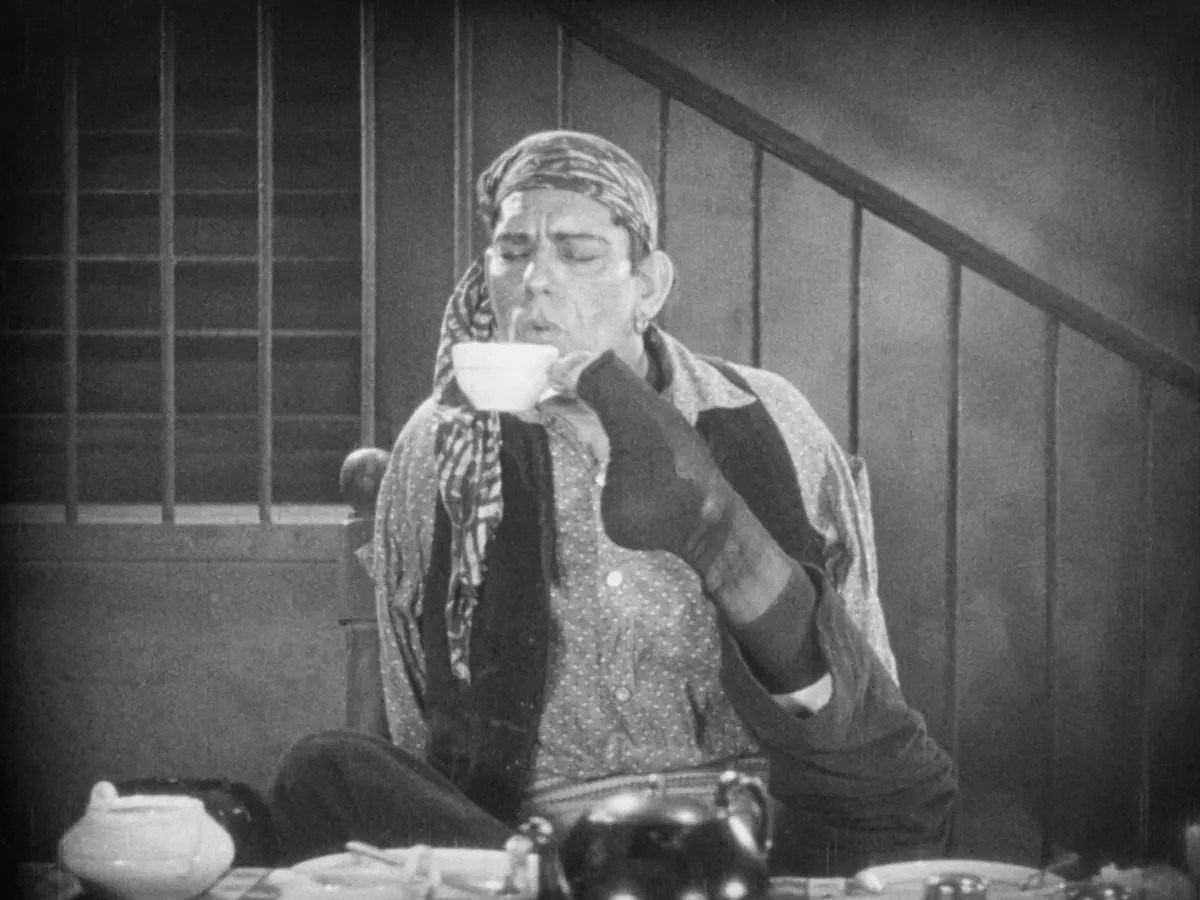
Alonzo, involuted
The Unknown (1927)[3] expresses such a process in libidinal terms. The film’s arc moves from mutation to mutilation: Alonzo is a wanted criminal with a polydactylic left hand, who hides his unique signifying trait by embedding in a circus in order to seem an armless talent with a freak podiatrist’s act, throwing knives with his feet. At the film’s outset, Alonzo is already in a constant straightjacket and presenting as armless, in a sense mimicking D&G’s masochist, who uses fetish objects and a dominatrix to construct a pain machine, a plane of consistency on which an excited libido circulates. Alonzo’s genetic mutation flows into his sartorial one. His double-thumb is mutated — muted — into artificial armlessness. This is a move toward insensibility, transforming his deformity into a greater deformity by a kind of subtracting mask. But this subtraction is duplicitous, illegitimate, and insufficient to secure the affection of the beautiful and neurotic Nanon. Subjected to the other performers’ constant molestations, Nanon has been conditioned to detest the touch of men’s hands. Browning engages Alonzo and Nanon in a psychic feedback loop, a dramaturgically engineered reinforcement machine in which Alonzo’s apparent armlessness confirms Nanon in her phobia, while Nanon’s puny kindnesses excite Alonzo to monomaniacal obsession and lust.
This feedback loop is libidinal, but not cybernetic; it’s rather cyberpunk, following Fisher’s definition. There are hints of tumescence, erection, penetration. But these, the normal and positively expressed organs of sexual and romantic interest, are converted, erased. When Alonzo undergoes a blackmarket amputation of his arms, we understand that he is constructing a body aimed at precisely that “Outside” from and toward which cyberpunk spores.
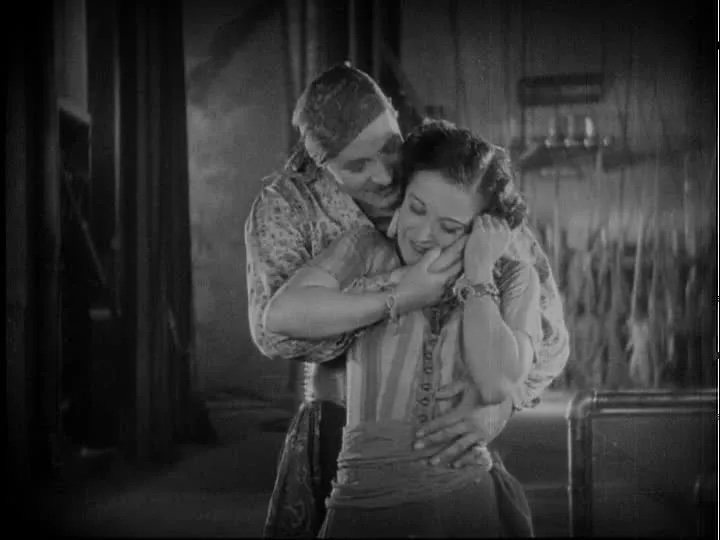
Nanon and Malabar
About the ethics of this, Browning’s film is ambivalent. Explicitly, the mutilation is tragic: Alonzo convalesces for months, during which time Nanon dissolves her phobia and becomes engaged to Malabar, the circus strongman. But Browning’s photography belies his deeper sympathy. Alonzo is a scoundrel, but Malabar is a heap of sinew, flesh. His gross bulk sweats. He moves more heavily elephantine than Joseph Merrick ever did. And when Malabar fondles Nanon, we see him exactly as Alonzo does. His paws are atrocities. We are repulsed by a body not given over to reconfiguration.
Freaks (1932) advances Browning’s flirtation with the Outside. It is irrelevant if we celebrate the film’s climax, in which the vengeful dwarfs and pinheads and imbeciles and hermaphrodites and sundry other freaks disfigure cruel Cleopatra. Even less relevant is the film’s own endorsement or condemnation of that tremendous violence. If Browning condemns Cleopatra’s forced and total dis-organization on moral grounds, it only proves the irrepressible attractiveness of the cyberpunk program, even when it runs counter to deeply coded norms of decency, dignity. Cleopatra is Browning’s stand-in and our surrogate, encountering difference as both attractive and repulsive. She negotiates with the Outside and succumbs to it.
Variable porousness circumscribes the freaks, and permits Cleopatra’s initiation into their secret politics. These are both communal and severe. The freaks maintain an auxiliary position relative to the larger body of the carnival: attached, but in the manner of a skin tag, tumor, or vestigial tail. Alternative freak values and private tendernesses reinforce the freaks’ alterity, and ward off their integration into that larger body, which they justifiably regard with suspicion. Once she is admitted into this excess portion of the carnival, Cleopatra finds herself increasingly repulsed by her incorporation into that mélange. Nevertheless, she seduces her dis-organization. It is Cleopatra herself who courts and intensifies the affections of the dwarf, Hans, and by extension all the intensities of freakishness. Cynically, immorally, but absolutely intentionally, she invites the Outside in. It is thus only conceivable that that same Outside would respond by violently abducting her to the periphery of social, physical existence.

The Human Duck
Browning refuses to portray that abduction, only the results. The dis-organization that climaxes Freaks is far more boggling and inhuman than that of The Unknown. Tarred and feathered, her hands melted into flippers, legs severed, vocal cords mutilated into a pitiful quack, Cleopatra is exhibited, a freak act called “The Human Duck”. It is a discomfiting vision of becoming-animal. But glimpsing Cleopatra’s reconfigured body, we more fully partake of Browning’s agony. His image upsets, but captivates. We become possessed of the competing drives that can instantiate the cyberpunk program, the simultaneous repulsion and fascination that cinches a body nearer to the Outside, the different, the re-organized.
But Browning’s grim, upset picture is not the only formula for dis-organization. If the cyberpunk program is to be at all desirable, it must invent a mode of dis- and re-assembly that is pleasant, touching, inhuman precisely in its surpassing intensification of what is most desirable for humanity. There is an alienation that is not equal to distress. Fisher invokes health, humanity’s “best interests”, as the engine internal to the Spinozan/Deleuzo-Guattarian program. What is a healthy body? What nurses a superman?

In his short film The Master of Shiatsu (1986)[4], the punker-turned-New-Ager Gakuryū Ishii visualizes a medicine that potent. It is bodily, and bodily unto the micron scale and smaller. It heals molecules, neurons, cells, AGCT bits. The middle portion of the short appears to occur in a space of nerves and synaptic fire. Against the chiropractor’s arborescent corrections, Ishii offers massage.
Unlike Browning’s programs, Ishii’s cannot properly be called sexual, although this is not to say that it is divorced from libido. Instead, Ishii depicts a dis-organization that is more creative than pro-, more productive than re-. In this mode, attraction, beauty, nudity remain resonant themes, but these consummate their intensities in a circulative, rather than penetrative, coitus. Rather than ejaculation, qi. Rather than release, increase. Fluids are not expended. There is only exchange, succeeded by mitosis. Autopoiesis.
The BwO is the egg… The egg is the milieu of pure intensity, spatium not extension, Zero intensity as principle of production. There is a fundamental convergence between science and myth, embryology and mythology, the biological egg and the psychic or cosmic egg: the egg always designates this intensive reality, which is not undifferentiated, but is where things and organs are distinguished solely by gradients, migrations, zones of proximity. The egg is the BwO. [5]
Ishii’s body is an egg that is always already fertilized. It forgoes umbilical cords for mycelial threads. It is productive of its own bioluminescence, which grows precisely along migrating slopes, gradient shifts. Most importantly, it is a body in which biology and cosmology converge. Ishii’s lady is composed of the same stuff she perceives. Fisher puts it nicely:
Paradoxically, the ultimate interests of any body lie in having no particular interests at all - that is in identifying with the cosmos itself as the BwO, the Spinozist God…
Browning’s dis-organization, for all its genius, remains terrible. It cannot break from his essential cowardice. His is a cyberpunk of passivity, in which re-organizing forces seize their subject with or without her consent and fashion odder bodies after their own awful wonts. In any case, Browning is never more than a poor reactionary: difference and monstrosity triumph in his films, but this is despite his preference. Difference, although fascinating and pathetic, remains cause for anxiety.
Whereas the Spinozan project is essentially joyful, and Ishii envisions a dis-organization charged with bolder stuff than Browning brings to bear. His is a guiltless libido, uninhibited, self-generative, and Outside of Browning’s antagonistic one precisely because of its universality. All that remains for us is to incorporate its several conditions: bellowing laughter, the danger of slight touch, becoming-nude…
Works Cited
[1] k-punk.abstractdynamics.org/archives/003875.html
[2] Btw, this is a prism into how Deleuze marries Spinoza to Nietzsche. Glossed so succinctly, it seems obvious. Of course the immanent reorganization of the bodymind will make use of Nietzsche’s ideas about competing wills and organ sensitivities. See for instance Will to Power, 800, for a typically Nietzschean way of putting it.
[3] Full film: https://en.wikipedia.org/wiki/File:The_Unknown_(1927)_by_Tod_Browning.webm
[4] Full film: https://www.youtube.com/watch?v=NhK4_owcy50
[5] Deleuze, Gilles & Guattari, Felix. “How Do You Make Yourself a Body Without Organs?” A Thousand Plateaus, trans. Brian Massumi, University of Minnesota Press, pp. 164.
-- becoming-insensible writes on substack.