

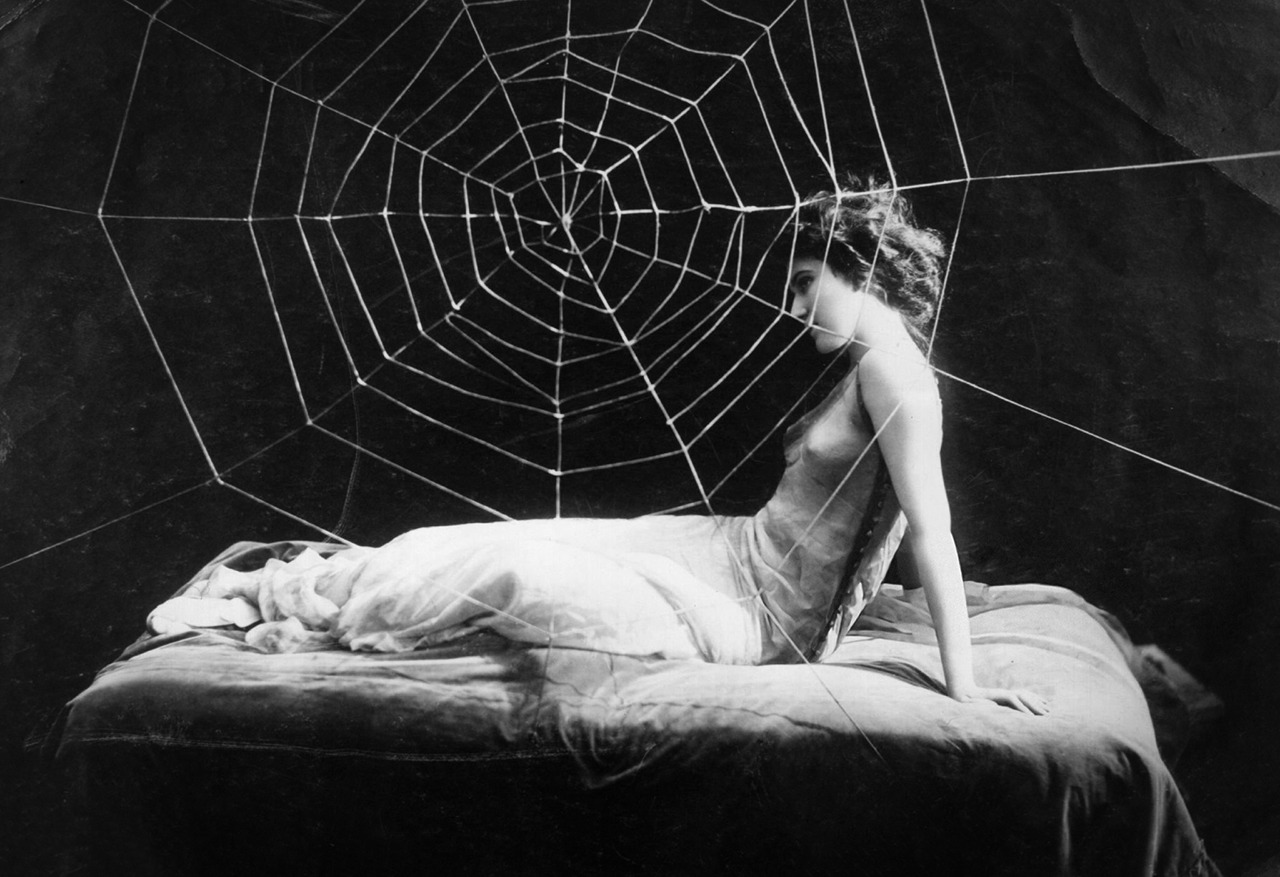
The blue that morning is overripe, the sky near bursting. Through the window she can almost glimpse where the skin is thinnest. Her own lies under a bolt of polyester, gold and fraying at the seams. The air is stale with industrial carpet, of solvents banned in other countries and cigarettes ashed and now pined for. Her eyes cast over what money has afforded her, the rotgut endemic to rooms like this. Like her the decades have staggered in, reeling with the loss of time. She finds their hairs on the pillow, the dead leaves they’ve tracked in.
It was cheap, this room on the seventeenth floor. She has a view to the alley and to the edifice across, the sum that of a backsplash tiled in brick. A dumpster has been left to yawn, and snow is drifting in. Everything is smudged by gray indifference, and through a crack between buildings she can just make out the river.
It’s all she can do to get up and stumble into the washroom, where the lighting is harsh. She relieves herself in the walled off lavatory, spoiling the neat triangle on the nearly finished roll, and then with a cake of soap she washes her hands, tossing the embossed paper into the bin near the door. She dresses quickly, in a turtleneck and jeans, not bothering to embellish, as she’s unlikely to remove her parka. She laces her boots, zips up the shell, and grabs the key card from the slot over the switch. In the elevator she glances at her reflection. It appears wide and swollen, as if the person it belonged to had endured a long night.
Outside, she winces in the sunlight. Her hands spring up to improvise a brim before retreating back, reproached, into the pockets of her coat. For a while she thumbs plastic, rubbing the key card like a talisman, and then just as absently deposits it into her jeans, awkwardly lifting a panel of coat. She scans left and then right, and only in one direction does the sidewalk continue. She chooses right, and as the curb gives over to road the honking picks up until flatlining into a steady drawl. Across the way are a set of tracks. Without thinking she makes for the concrete median, obliging the traffic to slow. Once there, shaken, she looks out from her new vantage and spies a tunnel farther on, where headlights peer out from the swaddled dark. She watches, absorbing the make and model of the cars, their salt-encrusted states. Then, in a fit of irony, a cyclist comes through, shy like a debutante.
Nearby is a sign which she reads in French and then English, though most of the lettering is taken up by numbers. There’s a bench but no shelter, and on it only one person sits. The rest stand or else pace, expelling hot clouds like hard-working engines. She walks to the stop. There, she sees a man leaning against a trash can. He’s skinny, underdressed, and young, his face blemished but not pockmarked. From his jacket he takes out what looks like a stick of incense, the outside powdered as though with mildew. He lights an end with a struck match and then, satisfied, blows out the flame, breaks the stick in half, and lights another end. Blowing this one out he brings the smoldering tips to his nostrils, so that for a moment he resembles a walrus, and snorts. She looks away just as his voice dissembles into a dry, heaving thing that she can’t decipher.
The train comes, and in the car she sits across from a young mother. She’s also underdressed, in a denim jacket over a bulky sweater, and a pashmina wound round her neck, compensating with modest luster. The baby on her lap, in turn, is wearing a bright red snow suit in a nod, it seems, to the red motifs she sees everywhere in that city, as they head into downtown: on storefronts and on lampposts, their banners flapping in tandem with the nation’s flag—a flag to arouse juvenile submission, fealty to a seemingly benevolent father. It’s the only color she registers anymore, as everything else is rubbed in newsprint.
She steps off. It’s nearing midday, and the pubs are beginning to fill. She presses on, passing bistro after bistro inscribed with the article L’. Eventually she arrives at a café where all the pastries are cream-filled. Choosing one is to choose by degrees of pornography, so she settles on one that’s nearly spent, more disgorged than the others, and dipped in chocolate. She eats it standing up, wetting her mouth with weak coffee, then wipes her hands on the seat of her pants. No one notices her leaving.
A few blocks away is a bookstore of some renown, it being a literary city, a place with some heft. She walks into a field of gleaming white, the counters and bookcases laminated and nearly bare. She’s surrounded by tongues, and in one she knows she hears a woman expound to her husband on the redesign, having read about it that morning in their hotel lobby. How the bookstore had contracted a Swedish firm to streamline its displays, so that only a handful of titles remain on the shelves. The rest lie catalogued in drawers without handles, interred like bottles of overstock perfume. The Swedes, the woman says, are a hard people.
Past the entryway the store opens into a hall that’s furnished with plush chairs and tables. On one, assorted biscuits have been fanned like playing cards, and a large urn of hot water sits on a trivet. Next to it are tins of loose tea in a variety of blends that reference the city, their names arch, as if to preempt any reflexive derision. She grabs a mug but waffles over the selection, now faced with the anxiety of choice. Seeing this, an elderly man reaches across for a mesh strainer, into which he spoons leaves heady with bergamot. With a shaking hand he places it over the mouth of her cup, and then looks into her eyes. Always add milk before steeping, he cautions.
She searches for a pitcher but doesn’t find one, and so abandons the prepared mug on the table. She picks up a monogrammed napkin and folds it over a shortbread finger. Pocketing it, she walks to the end of the hall and pulls on a door marked NO ENTRY, taking the service stairwell all the way to the lowest floor. There, as with any unfurnished basement, it’s all cement and drywall, and row upon row of metal shelving. Fleshing them out are a surfeit of words and pictures, bound and closed, and boldly suggested by their spines. To see them billeted underground, the sheer volume of their numbers, is to be scalded by language. She feels at once betrayed, and disposed of naivety. Her own ideas and musings are but a drop in the bucket of consciousness, and once she’s seen it she can’t unsee it: the sheer banality of thought. She sighs, moving on.
Scattered everywhere are toys: plastic dolls and towers of wooden blocks and mats in jigsaw shapes and stuffed animals and remote-controlled planes and pedal-driven cars and yo-yos and board games and playpens with light-up mobiles. For a while she wanders through the labyrinthine warehouse, as pieces of cookie skitter off her coat. She would normally be exposed under the fluorescent light, but since she’s alone she only feels cold. She presses her body against a shelf, where the shadow hangs sideways, and exhales as if a stethoscope were aimed at her back. At the sight of her breath she relaxes, as one who despite all logic has received good news. Her corporeality beams.
Farther on, near the docking station, she comes across an empty cart swathed in canvas. It looks ample, friendly even. She attempts to climb in but fails to get purchase, the sides being too high. Looking around she spots a rocking horse some meters away, and so, with some effort, gets behind the cart and rolls it over. Once they’re in parallel she steps onto the horse’s back. Then, in an inverse of mounting, she bestrides the cart, and tips over and in.
It’s warmer inside. The fit is snug, and so she twists her body into a fetal position, embracing herself as she did in utero. She unties her boots and shimmies out of her coat, and one by one pitches them out of the cart. Then, remembering the key card in her pocket, she tosses that out, too, and so with it the last token of her previous attachments. She collapses back, lighter, and stares up at the high ceiling.
Overhead, the light is blue. She closes her eyes so that everything turns yellow and the red is finally stamped out. She sees buttercups, then stars, and then time itself flits over her lids, to wink like an ember. Her thoughts bleed into shapes and rudimentary figures. It’s all roughly drawn, and as she sifts through the images she pauses on a frame. She is standing before a classroom, in all the garments she has just shed, her parka done up to her chin. The teacher is reclining behind a large, peeling desk. Their respective sizes suggest that she and the teacher are the adults in the room, but really—like the twenty or so shifting in their seats—she is just a child. And as with the other students she has been asked to account for her time away. She begins to tally the episodes in her head: the everywhere and nowhere of it all, what little substance goes into a day. Yet when she opens her mouth to release the words nothing comes out—only a whisper of smoke.
-- Jessica Kosti is a writer and former journalist living in Pittsburgh.