

On Elytron Frass’ Moieties
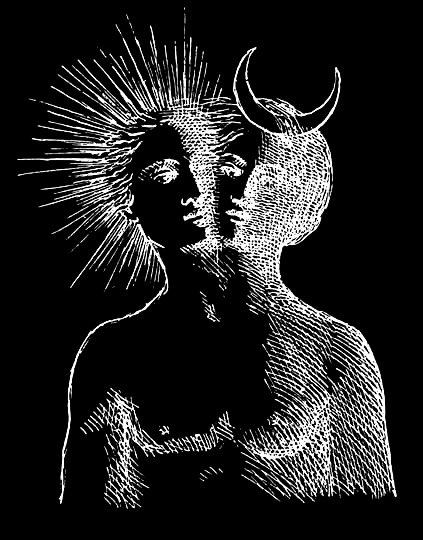
Basilius Valentinus (Azoth of the Philosophers, 1613) is commonly credited for the original representation of the Rebis—an emblem of the male-female alchemical twins, symbolizing the final product of the alchemical magnum opus. In the alchemical process, after the undivided one has gone through the stages of putrefaction and purification, the previously undifferentiated opposing qualities are reunited in what is often described as the “divine hermaphrodite”: a being of both male and female qualities as indicated by the male and female heads attached to a single androgynous body. From Plato to Bataille eroticism becomes the re-enaction of an original hierogamy in which both sexual drive and the desire of knowledge are fueled by a feeling of incompleteness, and oriented towards the ideal of completion.
Completion, however, is not a telos anymore. Contemporary science and philosophy have substituted the pleroma for a proteasome: reality is an unfinished and ongoing assembly process in which, as Iain Chambers has written, artworks reveal “not so much a distinctive ‘message’ as a sense that is ultimately a non-sense, a refusal to cohere that opens [into] that void which resists rationalization.” A rationalist pleasure is neither sought nor confirmed — “a border, an intimation of the sublime, the shiver of the world, an encounter with the angelic and the extraordinary, is declared. We are taken beyond ourselves into the eroticism of time and the subsequent sense of loss that proclaims an identity,” but identity has become a false idol, it is “the opposite of authenticity, always had been” —writes Gary Shipley in Terminal Park.
While alchemy and Gnosticism — two of the main conceptual referents of Moieties— have been historically committed to the integration of the opposites, Elytron Frass’ symbolic speculation is by contrast directed to the hysterema inscribed in the fine line between the fleshy image of the body and the functionalist image of the mind: between fiction understood as magic and science understood as fiction. Here, fusion and split become the same movement, pointing towards the impossibility of a one-and-the-same being; a paradoxical displacement — meant to transcend both monism and dualism — which might be solely communicated by the shared metaphors and symbols composing a narrative imbued by mysticism and martyrdom, yet seen through the lens of modern science, body horror and eroguro:
The Fetishist and I fell to the base of the pit of simmering eye gore. She padded my fall, and I lay atop her. I wrestled her rubber-lined body, grappling her in the gore-laden shallows. I told her I'd want an intimate moment with her, before making her into a corpse. (Moieties)
Moieties is a neurogrimoire about a couple of craniopagus sesquizygotic conjoined twins of opposite sex:
—an anomaly layered in implausibility, accentuated by oddity. Thus, with Subject L born female, and Subject R, male, they are semi-identical yet fused together at a portion of the skull. (Moieties).
Subject L and Subject R are two halves of a split brain, communicating to each other via a haunted telepathy, while being subjected to the neurosurgical attempt of separation presented as an alien autopsy. The book is split in two halves progressing in opposite directions until converging in the middle, like Milorad Pavić’s masterwork Dictionary of the Khazars. The stories composed by L and R reproduce complementary dreams, hallucinations, and experiences which transform on the go into depraved perspectives, anamorphoses, and aberrations:
Given an advanced handwriting assignment, in which Subjects L and R choose to compose an original story, each body's dominant hand takes on a key role to complete each other's words and sentences in real-time (Moieties).
In the 1950s and 1960s, Roger Sperry performed experiments on cats, monkeys, and humans to study functional differences between the two hemispheres of the brain. To do so he studied the corpus callosum, which is a large bundle of neurons that connects both hemispheres. Sperry severed the corpus callosum in cats and monkeys, to find that when those two hemispheres are not connected, they function independently of one another — a phenomenon which he referred to as a split-brain. Later, Sperry tested the same experiment on epileptic humans, hoping to treat their epilepsy by severing their corpus callosums. Yet, he found — among other things — that the human brain hemispheres are involved in some different but complementary functions:
For instance, if Subject L was beginning any initial half of a desired sentence or word on her left-sided page, within their shared composition book, then Subject R would be completing that sentence or word, in sync with his sister's efforts, on his right-sided page (Moieties)
Some decades later, neurologist Todd Feinberg described patients with various split-brain syndromes: in one manifestation, a patient might find that one of his hands is at odds, or all-out war, with the other. Yet, aside from the alien hand, the patient still feels essentially like himself. Such patients, Feinberg writes, “act, feel and experience themselves as intact.” Feinberg concludes that the brain labors to create a unity of experience, a consistent feeling of individuality and agency. Some years later, speaking about a case of twins joined at the head in which brain imaging revealed an “attenuated line” stretching between their two brains forming a kind of "thalamic bridge,” Feinberg refers to it as a “shared brain made of two brains,” and explains that “it’s like they are one and two people at the same time.”
Neuroscience is essential in Moieties, but nevertheless secondary — a set of literal footnotes expanding across a visually powerful and structurally complex book. Along with footnotes, the novel is full of textual, iconic and graphic symbols enriching each other similarly to the hermetic and religious books from the Middle Ages: the main text is accompanied by sidenotes, medieval style marginalia and miniatures, allegorical diagrams and connecting lines that illuminate the two converging storylines, each representing a different collection and interpretation of the memories and imaginations that were once shared by a common but dysynchronic mind. Elytron Frass mobilizes metahistorical anachronisms to explore our contemporaneity, including an enigmatic fetishism for dark medieval archetypes, resourcing to legendary accounts of the sophisticated tyranny of the religious powers, the cruelty of torture, and the decimating plagues — the way that late 19th century French authors Octave Mirbeau and Marcel Schwob did in works such as The Torture Garden or The Children’s Crusade. Moieties is a prodigious example of the neo-symbolist style which keeps flourishing in the 21st century:
You spoke of the Lucent, the third of the Seven Enigmas, having duplicitous powers, abilities to reflect artifice rather than merely the thing that its mirror flesh sees. You guided me, as I requested, towards a curious body of light—certain that this was the one called the Lucent. It was important, you had insisted, that I decouple—shadow from body, body from shadow—prior to facing this adversary. (Moieties)
Neo-symbolism is, perhaps, the most evident artistic manifestation of an occult rebellion against the late, re-territorializing stage of postmodernity working on the contemporary psyche to produce transparent identities. Maybe it’s also the footprint of a quest to develop less deterministic ideas of socio-technical evolution, and it is, probably, the consequence of having to cope with a much higher level of indeterminacy than we were used to. Neo-symbolism acknowledges that, despite social and technological advances, we struggle to live in profoundly ancient times, and all ideas, ancient or modern, theological or scientific, influence the way civilization organizes itself by perpetuating the tales we tell about ourselves. From the occult mysticism of the anonymous and pseudonymous texts published by Gnome Books to Bogna Konior’s idea of cyber-mysticism, the impact of a symbolist collective reading of the material universe seems to be returning as a legitimate element of philosophy and the arts. Contemporary symbolist aesthetics is evident in the work of authors like David Roden, Robert Kloss, Ansgar Allen, Jason Schwartz, Gary Shipley, Louis Armand, Michael McAloran, Mike Wilson, Joyelle McSweeney, and many others, evidently inspired by the French symbolists‘ style, but also by early and mid-20th century authors like Jorge Luis Borges, Bruno Schulz, Antonin Artaud, Franz Kafka and Pierre Klossowski.
As above, so below. In 1495, a pair of female craniopagus twins were reported in a small village near Worms. The girls died at age 10; one sister died first, the second dying from an attempt to separate her from her dead twin. They were described by Ambroise Pare in Of Monsters and Prodigies, among other rarities and fabulous beasts. Soon, that rarity became an emblem. Fusion and separation are one-and-the-same movement towards an impossible underworld:
I'll conjoin our bodies; we'll become a novel rebis and dethrone the Godhead—simultaneously bound in life and death, in love and hate, in ripeness and decay, I offered. (Moieties)
Showing the network of connections between different systems of knowledge, Athanasius Kircher inoculated the metaphysics of light through all traditions of philosophy, religion and science. He also tried to show how, in specific conditions of reflection, light might become a monster. In Moieties, Elytron Frass develops a narrative theory of the theratonics of love — since “a body,” as David Roden writes, “in the ending, is the nectar of time” (Xenoerotics) — showing that aberrant cognition deploys a phantasmagorical field which is an important source of knowledge and pleasure—a knowledge that cannot be embraced, neither ignored.
-- Germán Sierra is a Spanish neuroscientist and writer living in the internet. He has recently published The Artifact (Inside the Castle, 2018), Fabulae (Oneiros Books, 2021), and Interstitial Artelligence (Centre for Experimental Ontology Press, 2022) in collaboration with Brazilian philosopher Emanuel Magno.
Elytron Frass' Moieties can be pre-ordered here: https://subtlebodypress.com