

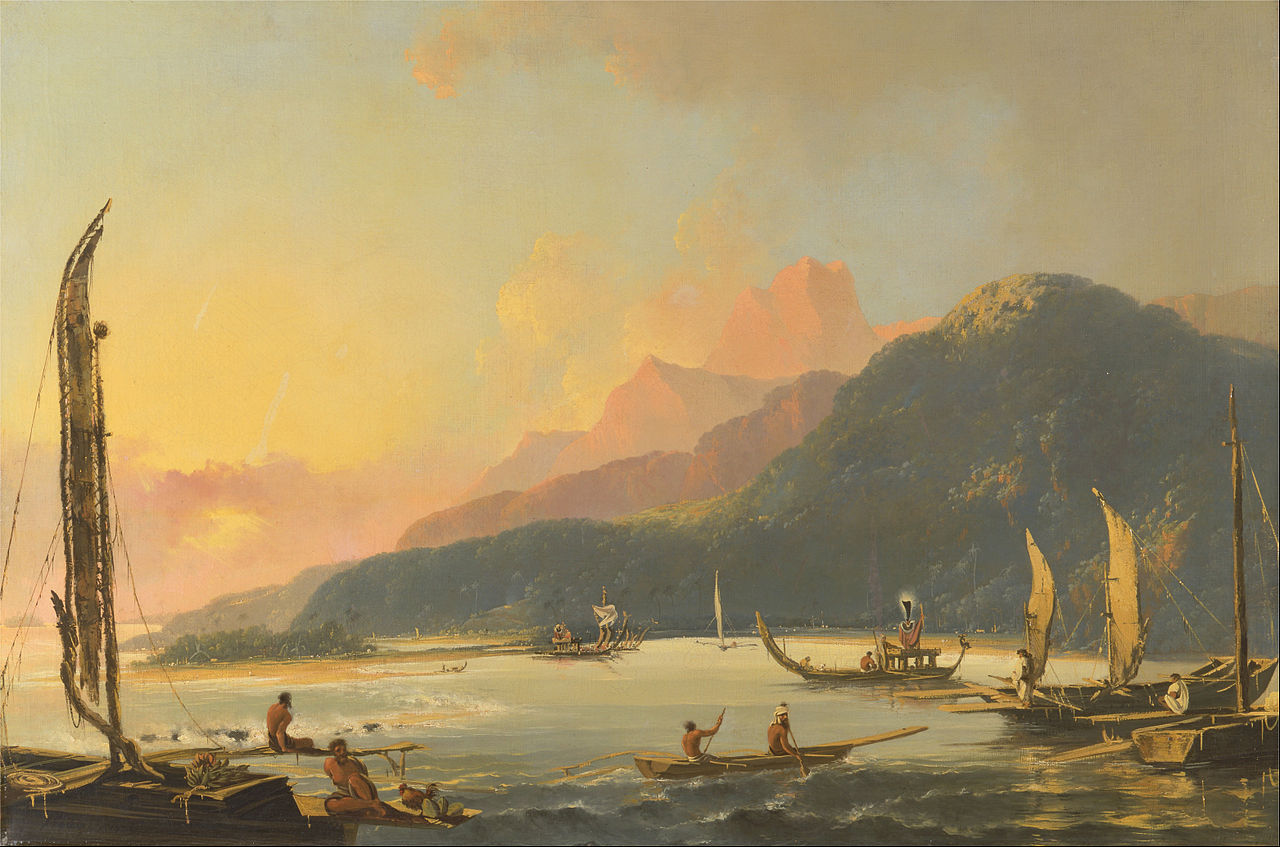
In one of Bligh’s books, perhaps Carteret’s Voyage Round the World, he reads of four Pacific islets, the main one with rugged crags, plant life, and a waterfall, sighted by The Swallow. A waterfall! Possibly unexplored? They leave Tubuai, abandoning Fort George according to their vote. Now, four days later, back in Otaheiti, Fletcher observes Morrison, Stewart, and wild Quintal hail their lovers who climb, flowers in their hair, deft, urgent, to Bounty’s loaded deck where they press, flesh to flesh, their returning mutineers. Stewart’s baby daughter cries, excited, her daddy laughing and sobbing. Friendlier than the unFriendly Isles, quips the wryly literate Morrison after Chapter Two of their troubles in Tubuai.
Energized, everybody strives, unloading gear and livestock ship to shore, buoyant with love, especially the natives’ for their Titreano who shall have reason to feel uneasy when these long days’ labor, then music and feasting, are done. All agreed he should have The Bounty. Those who don’t stand a chance of acquittal, eight of his men, will continue sailing with him in search of a haven, the rest electing to remain in Otaheiti. The skeleton crew has its share of supplies, native men, and some women, including Fletcher’s high-born love, Mauatua.
You can fly across the Pacific in a window seat for many hours without seeing land yet more than 25,000 islands speckle its swell. Who has never enjoyed a reverie about a perfect uninhabited island, or is unfamiliar with Robinson Crusoe’s situation? But before 1789 every island between Hawai’i and New Zealand that could sustain life had been settled at some time. Fugitive Fletcher can’t leave Otaheiti soon enough, reminders of human sacrifice displayed, skulls, bones, even still rotting flesh, locals inured to its stench that troubles Europeans. Learning of a plot to wrest the ship from him, Fletcher, several stowaways aboard, slips the cable quietly overnight without alerting anybody. Some visiting the ship jump overboard when they realize they are underway. No farewells.
Their ensuing four-month long zigzagged odyssey, a constant wap-wap of wind on sail, includes Rarotonga and Mangaia stopovers where the heavily-laden Bounty appears on the horizon to local natives as a floating island. Here, a mutineer shoots dead for no reason a native Fletcher befriends. Outraged, master of the quarterdeck but holding power no longer, Fletcher can only deplore this insanity, shouldering an escalating burden of guilt. Cleaved from his prominent family forever, another book he shall read is his bible, today’s Pitcairn Bible, when he leads services for his volatile mixed-race clan at final landfall. Three days before Fletcher turned twenty-five barely a soul witnessed Bounty’s faint tracery of sails leaving Tahiti for the last time carrying a yearning for freedom weighted with regret.
Previous
-- Ian C Smith’s work has been published in Across the Margin, BBC Radio 4 Sounds,The Dalhousie Review, Gargoyle, Griffith Review, Southword, Stand, & The Stony Thursday Book. His seventh book is wonder sadness madness joy, Ginninderra (Port Adelaide). He writes in the Gippsland Lakes area of Victoria, and on Flinders Island.