

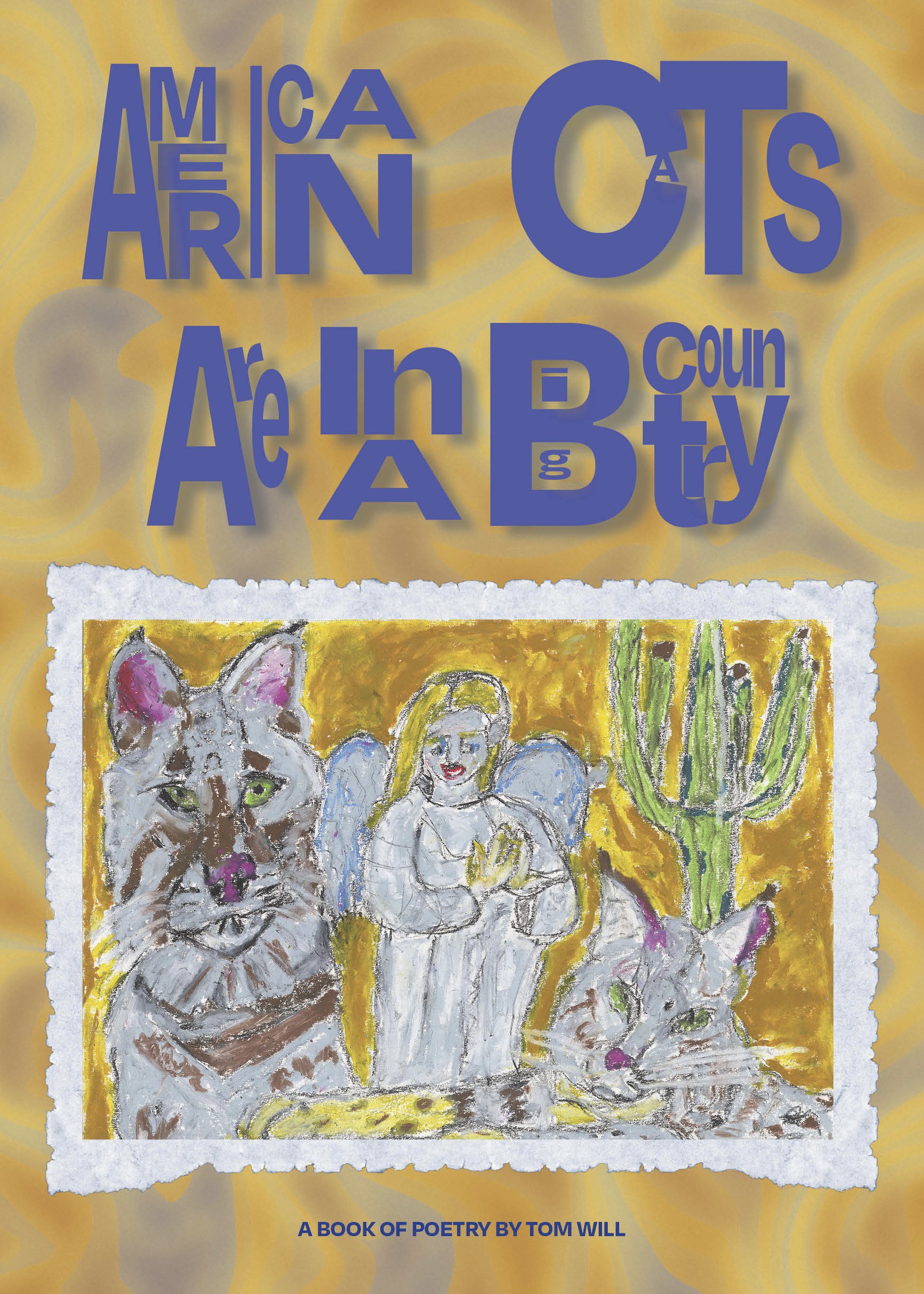
American Cats Are In A Big Country by Tom Will is available now, via Farthest Heaven
I recently became aware of the fact that not all of my readers live inside my head. In fact, possibly none. One instance in particular stands out to illustrate just how I came to this realization. I had written a book called Pale Townie, and a friend of mine did not know what the word “townie” meant, which was a fairly important word as far as words go for this particular book. This friend was, I found, not living in my head; and as a matter of fact he was living quite far from me altogether. He was living in Australia where the word townie is not in common use at all. And if the shoe were on the other foot, I would imagine a great deal of my fellow Americans would not be filled with a rush of context and understanding should they come across a book of poetry titled “Pale Bogan.”
So from this we can go forward assuming that not only are my readers not in my head; but we can even go so far as to assume that any given reader is not in the head of any given writer.
And yet strange things happen. I read a book I have never read before from 100 years ago, a book of some poet who I ought to have read earlier, or ought to have read more completely. And in that book of poetry I find something I had previously thought was solely mine. The astute reader of poetry will find an appalling number of occurrences such as these in my latest volume of poetry, American Cats Are In A Big Country. A few examples off the top of my head. Bukowski talks of a creek crying, Hopkins talks of leaves on a tree being beak-like, Berryman has a sonnet on suicide whose premise is near identical to mine. All these occurrences I found out well after the fact of writing my own poem, in darkest shameful ignorance of the fact. Each new poem I read is another time that this can happen.
Although this strange thing is largely one of the greatest and highest graces of poetry, there is not too much more I can really say about it without coming off poorly; either by inflating myself grotesquely or shrinking some great poet carelessly. And it is so tempting to find a more reasonable explanation like, “He read that Bishop poem before and fool that he is he forgot,” or, “He is lying because he is a poet and poets lie,” or, “There are a finite amount of things that a small pointed leaf in a tree can resemble and I am in no way surprised or mystified that someone else thought of a beak when they saw such a tree.”
And besides, an introduction to a book of poetry would not be the place for a discussion of this. It would be, and is, a question for a poem. Only a poem can answer a poem well, and poems such as these keep us company whose job it is to be in solitude. They keep us company by telling us that someone wants us in their head. But I’ve said too much on this already while not doing it the full justice it deserves.
No, the introduction to a book of poetry is not for this sort of talk. It is for either a credibly more well-established poet to write a 2-3 page blurb that won’t ruin the cover art; or, it is the place for the poet himself to niggle over some thing or the other like sprung rhythm or the necessity of the reader whispering each poem sibilantly to himself upon first encountering a new poem or some such along these lines.
I am here for the latter. I am here to niggle. I am here to plead my case regarding my use of the semicolon in my new book, American Cats Are In A Big Country. I am pleading this case because: I am now aware and becoming ever more aware by the day that people do not live inside my head regarding anything and least of all regarding typography; and it has been brought to my attention that some people do not like how I use semicolons, or at least see how I use them and wonder why I am using them in such a way, when the words were doing just fine all alone before I came along and sprinkled one predominant part of speech among them. For what purpose has this been sprinkled? And why this part of speech and not another? And why in such large numbers?
***
Overall, regarding punctuation and poetry: I do not like using full, pure prose punctuation in my poetry. I cannot stop thinking of the poem as a work of prose when I do that. I cannot stop thinking about sentences. It gets me thinking about the wrong things altogether. It gets me thinking about traffic cones when I should be thinking of the image of the poem or some image giving way to another in the poem.
I am not choosing the traffic cone metaphor lightly here. I really think about punctuation in my poetry in terms of traffic. To walk further out onto the metaphorical tightrope; I see the semicolon as a flashing red traffic signal at midnight in some charming smallish town (or a town or city of any size so long as it is appropriate to the poem); stop then proceed, keep an eye out if anyone else is coming to the cross street. Normal daytime traffic patterns of red yellow green, of commas periods and the whatever of the daytime are lifted at the moment because it is nighttime when traffic signals are pared down to the simplest elements for convenience. And of course this is the most pleasant time to be driving, when traffic signals are more suggestion than rule. As we have said, the poet’s role requires solitude, so it is no real wonder they are so suited for driving at the later, emptier hours.
But of course the traffic laws at night are based on the daytime rules of commas and periods. The semicolon in my poetry lies somewhere in the middle of them; it is a brief pause that can be longer than a comma or shorter than a period. But it is nighttime and not many people are around to see how long you stop or do not stop for.
I do not mean to imply that every time I use a semicolon it is one image giving way to a new image, although this can often be a very sensible use case for my semicolon. "Mulebold; and sheepbold chickens" being an example of a line broken up by the semicolon for purposes of tempo and not of image. It is one image as a whole, and it really happened, chickens blocked the road. The brakes needed mashing in the poem for a variety of reasons and in real life for a variety of reasons. This defense of mine is of course wide open to all sort of horrible abuses as it is a metaphor and not logic.
And it is not like I have forsaken all other parts of speech in American Cats for the sole worship of the seductive semicolon (however, the astute reader will note at least two books where I did in fact forsake all other parts of speech for the sole purpose of the seductive semicolon). We have over a dozen exclamation points in this book, and just a few less question marks. We have, I think, a good deal of periods due solely to the prose poetry in the book (no time in this introduction to defend the prose poem, but the prose poem has been around as long as the hater of the prose poem and it has managed just fine and as its name would suggest it is ruled by the laws of prose). And we have some commas. But in all of these poems I hope that their punctuation feels needed and I hope their seduction is felt. One thrust wants another, one drift wants another drift. One semicolon wants another semicolon.
And the gordian knot-cutting appeal of simply removing all punctuation is not lost on me either. I understand and enjoy fully the poet who has been seduced by it. It too seduces me. It tells me that less punctuation in these poems would make for a cleaner read, would let the lines stand on their own legs without some dandyish canes sprinkled around them. But I think, so far, that the argument that less punctuation=more meaning is a false one. Or maybe it feels false as in it (more meaning) is being presented as necessarily the highest good when I disagree that it is necessarily the highest good. And I do not think less accenting to a rhythm means more dance. And I think punctuation does more for helping rhythm than it does for hurting possible meanings.
-- Tom Will has previously published 3 collections of poetry. His fourth collection, American Cats Are In A Big Country, is now available from Farthest Heaven. He lives in Tennessee. You can email him at tomwillwilltom@protonmmail.com.