

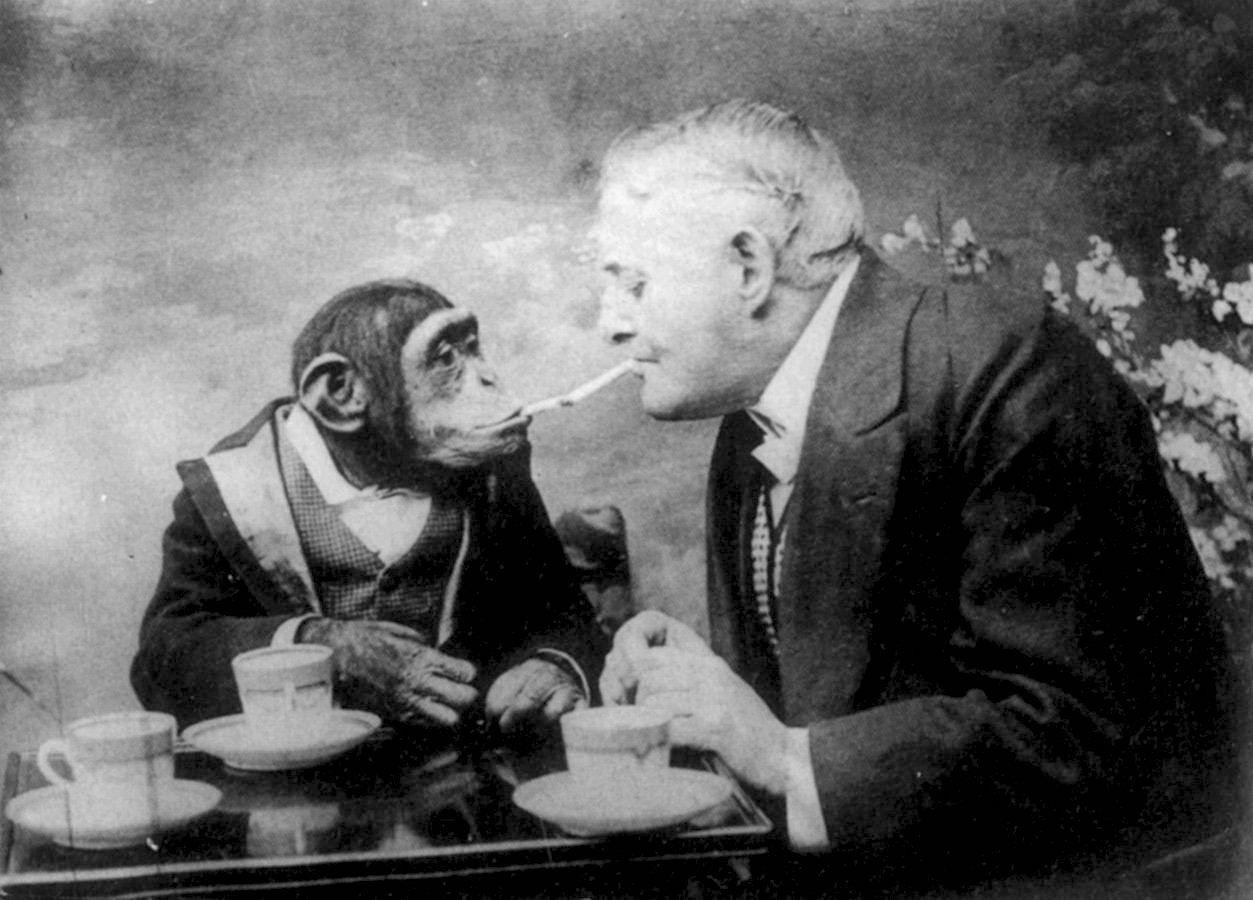
Africa, 1896:
Richard Lynch Garner, progenitor of a new science, sits alone in a cage. Pith helmet, blunderbuss, walrus mustache—his is the colonial uniform. The regalia of conquest and subjugation. Like the patterned fur of some violent beast.
He sits alone in a cage and dreams of monkeys.
They approach infrequently, one at a time, with a sort of startled fascination, a cautious interest that morphs into delight once he begins to mimic their sounds, their inscrutable language. He knows they speak to each other, and he knows that one day they will speak to him as well; he plans already, in the utopia of his head, the traveling show he will take across America, the crowds gathered in ecstatic mobs to hear the speech of a monkey, to hear proper English fall from the lips of our primitive primate cousins. And what will they say? Well, whatever he teaches them: words of love and kindness, mostly, some old family-friendly jests, maybe a few curse words for the raucous and rowdy drunkards making late night visits to the circus. And really, what more needs to be said? He smiles as the future unfurls before him: monkeys brought into the bosom of society, into the perfected world of technology and labor, diligent workers, the best among them maybe even ascending to positions of authority, their hirsute heads bursting from bespoke suits expertly tailored to fit their tiny forms. As for humanity? An endless idyll, a sweet, lazy paradise cooled by the breeze of palm fronds in perpetual motion. And he, of course, the rightful father of this reality. In the early days, the speech of the monkeys would be entirely mediated through him; the almost unbearable authority of the translator would be entirely vested in his person. He sits alone in the cage and pictures himself as a bridge between two worlds.
He is so deep in his reverie, so far gone in the shape of things to come, that he is shocked when he notices the presence of three gorillas directly in front of him. The beasts speak, elated by something; a tingle of understanding runs along his brain stem. “I’m Richard,” he says. “Richard. Richard. RICHARD.” The gorillas hoot, gesture obliquely with their meaty hands. They want me to follow them, he thinks, and his body quivers with the historical implications. The first interspecies palaver, a thing that must be navigated with the utmost care, with the deft touch that he alone, as the foremost expert on simian speech, possesses. He lets off a few yelps, opens the cage, and traipses off into dense foliage, into the as yet untamed wild.
What he finds waiting for him is a vision of pure atavism: a circle of monkeys wailing, hammering their chests, pissing all over themselves. He recoils slightly, then quickly chides himself; even man, he thinks, did not emerge with table manners, even man took many centuries to reach Shakespeare and Shelley. Still, beyond this keen rationality, he finds that the display engenders profound discomfort, an edginess, the same as he feels back home in the presence of the insane and the indigent; his gun, he realizes, now sits alone in the cage, impotent. All around: primordial psychosis, the sound of howls escaping from contorted throats, the demented opera of inhumanity. Subhumanity. Gore-spattered fangs glittering in the moonlight. He breathes deeply, slows the blood in his veins—for him, only the future exists.
In the present, he falters: the words he tries to force from his lips seem inadequate, the concepts that rush through his head refuse the rigidity of articulation. And so he is a sputtering mess.
And so the monkeys turn and guffaw. The entire jungle landscape seems to burst into brutish laughter. One of the gorillas signals for something, grunts a malformed word of command to an apparent subordinate; before Garner can tell what is happening, the creature is moving towards him with a crude stone knife, really nothing more than a shard struck from the side of a rock, though still invested with the capacity to shear flesh from bone. From behind, leathery fingers pull open his jaw with such force that he worries about a permanent unhinging. The blade passes unimpeded into the cavern of his mouth; his tongue tenses, wriggles about like an animal with its leg caught in a hunter’s trap. It feels like ice, he thinks as the gorilla saws back and forth, it feels just like sucking on an ice cube.
Soon the human tongue is deracinated, moved into the primate’s mouth—for a moment, Garner imagines that the creature, aided by its new anatomy, will deliver an eloquent English speech, a paean to the importance of human-ape relations, or else a warning to ward off further civilizational incursions into the jungle. Instead, the monkey chews and chews as if working through a wad of wild grass. Once satisfied with the extent of the mastication, it spits a coppery paste into the dirt, grinds its foot into the squelching meat. Garner vomits into his lap, the color of cherries. In this, they understand each other.
-- Jack Kelly is a writer from Colorado. He took a class on primates in college.