

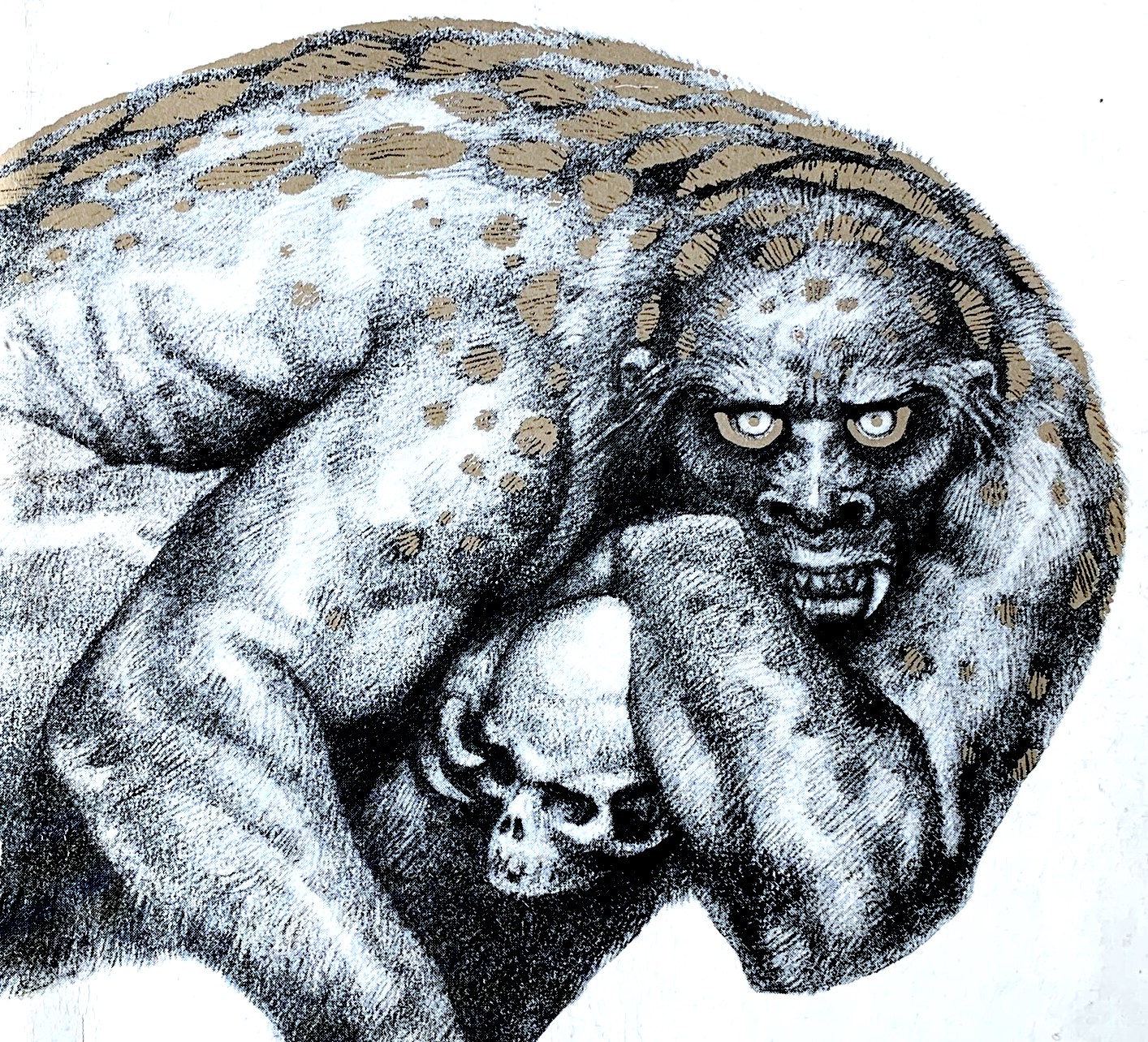
For over a year now, we’ve been subjected to terror. We’ve had our sleep wracked by terrible nightmares of fangs and fur; we’ve woken up the morning after to find them real in rosy sculptures of gore. At first there were signals, a sheep’s remains found in a meadow, a dog lost in the woods, but it wasn’t until people started dying that in hindsight we saw them as such. The carpenter’s daughter was the first — her body dismembered by the rivulet and found by the women going there to do laundry. We chalked it up to happenstance and mourned the loss as tragedy, as this world is often cruel. But we didn’t know cruelty yet. Soon after, hardly a day would pass without someone disappearing or finally found as a chewed cadaver. Everyone was game for the beast. Loggers, hardened men, would go into the woods and never return. In the fields, we found arms yanked at the elbow, still clasping lumps of seeds. Children playing by the edge of the woods — we recognized them later by their shoes still left on their little feet. Our village was a hunting ground for the beast, and a dining table for crows. So, we convened that a great hunt was to be organized, and all the hunters in the village gathered their hounds and departed at dawn. And we prayed to St. Marguerite they’d return triumphant, but, diminished in both numbers and health, they came back with stories rather than trophies. They said the beast was no mere wolf: it was as big as a cow and more cunning than a fox. It moved like the wind between the trees, black as the night and with a hide no bullet could pierce. And so death did not abate, rather it enveloped the village, as the beast grew bolder. I’ve seen it with my very eyes leap in broad daylight from a house roof, a black blot over our heads, and snatch a woman with its jaws. It played with us, innocently and absentmindedly, like a child who picks flowers in a meadow. My mother, among the others, was eaten on her way to buy food. Nobody was safe, and nobody dared to leave his house alone. The fields were then left untilled, the fam animals, as scant a number of them remained, left to forage for themselves. And in this way, our fear was seasoned with hunger. A handful of brave men were sent to ask the king for help, so that he would send his army and his best hunters, with well crafted arquebuses and bloodhounds. But help never came, and we just presumed our cries for help were devoured by the true sovereign of the land. Then we asked God for help, with prayer and contrition we asked to be rid of this evil — he offered only silence. The priest, led into madness, said we were lied to — that we weren’t made in God’s image. God, he said, more closely resembles an animal, an infinite hunger that fears no death and knows no laws except His own. God is an animal, he said, that’s why He doesn’t speak. Two days later, he was taken by the beast outside the church. We felt like the sons of the Egyptians, condemned to the tenth plague every night — but our angel had no sword and wings, he had fangs and claws. We imagined it passing through our town, the stillness of the night disturbed only by his mighty breath; and he’d survey his kingdom, while we rattled in fear in our beds, praying he’d not tear the door down and enter.
My sister and I have lived in abject misery for so long now, cloistered in our little home—our little Gethsemane. We’ve barred our door and forsaken the world outside. I couldn’t bear to lose her. We’ve eaten whatever was left in the house, no matter how moldy or rotten, until we resorted to frying the leather of our shoes, to chew on the wood of our furniture. Every rat that dared to sneak in was met with the same fate that awaited us outside and we ate the blowflies that blossomed from the corpses of our neighbors. My sister withered with every bite of our wretched meals, her cheeks hollowed out and her raven hair, once silky and shiny, came to resemble a tangle of old spiderwebs. We play card games every now and then, and she sings with whatever voice she has left. Only then I see the old gleam come back in her eyes. She once asked me why the beast didn’t end us once and for all. I answered that it’s impossible to divine the will of a beast. She retorted that man is also inscrutable. She pondered aloud about the Fall of Man, and of Adam and Eve having to now fear the beasts that lived peacefully with them in the Garden. I watched her anguish over our impotence, and rage silently against the walls of our prison. And when she gazed outside from the window, I combed her hair. I indulged in her dream of starting anew, somewhere far, in a big city where sturdy walls would keep all the wildness away. Maybe Paris, she said. But how, dear sister? How to escape if even looking at the landscape out the window comes with the quiet fear that just behind that tree in the corner of my eye there’s the beast watching me? In my heart I know that we have to hold the hinges of our door, seal every entrance lest our blood will water the beast’s gullet. The world is just this house, it’s just you and me for how many days we can bear to have. No one from the village ever came to check on us anyway. As both God and law disappeared from our village, decency and sanity also went away. At first, some took advantage of the situation like hyenas and plundered the house of the dead. A vain crime, as if the beast cared about the coins in their coffers while chewing their insides. Then something else, something altogether more removed from civility, sprung up. We’ve witnessed it flourish watered by blood and gore. We’ve heard blasphemous songs come from the deserted church, a handful of madmen howling to their new god. They worshiped the beast, they sang of its strength, of its teeth that bring a new justice, crueler yet fairer. Everybody, they said, was at the capricious mercy of the beasts, crime and sin forever abolished under the sign of the claw. There was no need for tribunals to discern the truth, no need to pay a priest to absolve you. Innocence was gained by passing through fear, they said. And they cavorted merrily under the moon for some nights, debasing themselves. I don’t know if in their last moments, when their god touched their insides, they felt any ecstasy, if their fear sublimated into pure joy. I dreamed I saw my sister among them, dancing naked and bloody by a bonfire. Then I dreamed I found half her face, torn and left on the stairs of our church.
One day, all of a sudden, my sister said we were going to leave. Prepare for travel, she said, have faith that the beast would not take us, for she had learned its secret. I feared madness had finally gotten the best of her. I grabbed her by her shoulder and caressed her bas-relief face. I reminded her that there was only death outside. She didn’t waver.
We would leave as soon as possible, she said.
We would have our last dinner that night.
She set the table, with all the fine cutlery we never use and put the pan to the fire. I wanted to ask, I wanted to stop her from wasting wood, but as the days grew duller and duller in our seclusion, anything that sparked curiosity felt like a balm for my brain. I found in me a perverse enjoyment watching her play pretend everything was normal. So I sat quiet and let her continue, watching with apparent concern, which turned real once she put a knife to her left thigh.
And then she cut.
She screamed and grunted and huffed and moaned, and removed from herself a slice of flesh no thicker than two fingers. You wouldn’t think there was so much blood in her veins, as gaunt as she looked, but it painted her foot red and soaked her ragged dress. She tossed the meat over the fire and let it sizzle. She looked at the waiting for reproach, disgust or something else. But the smell of the meat cooking in the pan, something I thought I forgot, put me in a stupor; for every part of me that was nauseous there were two that couldn’t wait to taste. I was salivating. So when she served it to me, slowly limping over to my side of the table, I grabbed it with my hands, no thoughts, no fear, and chewed on it till it was nothing. It was lean and chewy, the skin, slightly burned, felt crispy on my tongue.
She looked at me content, glowing, like she never did since the beast first appeared. And she caressed me while I was still savoring her flesh.
There are limits to language, she said. You want words in place of other words. I offer you things, I offer you myself. I could strain my tongue into weird contortions and growl my lungs away, but I won’t help you understand. I will never understand. Rather feel my flesh trickle down into your belly, I need to know what it feels to be eaten. I need to peer into nothingness, stand right before the point of annihilation. This is the teaching of the beast. Brother, take my flesh as communion, a sacrament for our safe passage out of this village. Tell me, do you care for another slice? The fire is still hot.
-- Vin likes to write and to listen to music. He also has got a substack he someday plans to write something for. Follow him on X @pinealbrand